


In this post, we will learn about straight and curved lines, which Euclid described and studied.
Many, many years ago (more than 2,000 years), Ancient Greece was a culture to which we owe an important part of mathematics. Euclid’s contribution was likely the most significant. He compiled everything known about mathematics up to that point into a series of books called The Elements.
Euclid dedicated many of his books to geometry (the Greeks loved it!). His work on this discipline remained intact until the 19th Century, and what was done afterwards belongs to advanced mathematics and is studied at university. This means that pretty much everything we study in geometry at school now was written over 2,000 years ago! This is why flat and spatial geometry is often called Euclidean Geometry.
Index
What are Lines?
Every line is composed of points, which are the smallest unit. One point, Euclid said, has no dimension: no height, width, or depth. So those points can only live in the imagination of mathematics because they are infinitely small.

A line consists of a succession of points. These points are so close together that, when you see them, they form one continuous stroke. Even with a magnifying glass, you still would not be able to see the space between the points; they are so close together.
Video about Types of Lines and Their Classification
To learn more about what lines are and how to classify them, take a look at the following video. This is from one of our interactive tutorials. Although it is not interactive in this format, you can still watch it as many times as you need to and share it with friends. If you would like to access our interactive tutorials, register with Smartick! The online method helps children aged 4 to 14 learn and practice mathematics.
Types of Lines According to Shape
Straight Line
A straight line is a succession of infinite points that are all plotted going in the same direction. They have no beginning or end; in other words, they have no limits.

Straight lines are endless, so you can never draw a complete straight line, only a portion of it, and we need to imagine the rest.
Curved Line
A curved line is a succession of infinite points that continuously change direction.

In the definitions, we talk about the directions of alignment that the point should follow, but what exactly does that mean?
The following image will help us understand it better.
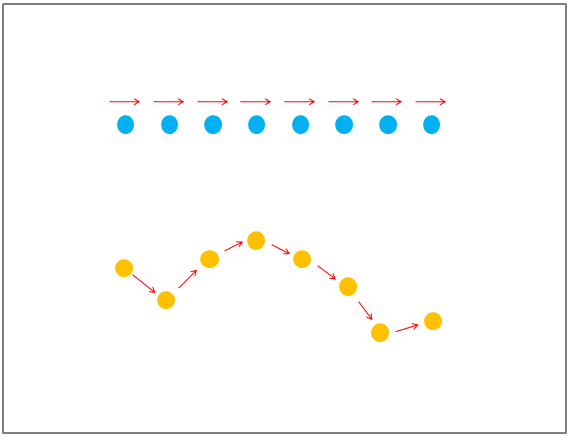
If we look at the arrows above the blue points (straight line), we can see that each point maintains the same direction as the previous one. The arrows do not change direction.
However, the direction of the arrow with the orange dots (curved line) does not remain constant. And this is the difference between straight and curved lines.
But this isn’t the only way to do it! The original way (the one used today in mathematics) is very similar to Euclid’s. Think of two points on a piece of paper, how many ways can you get from one to another?
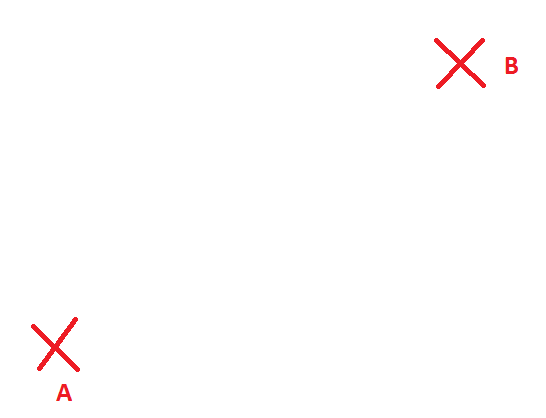
If there aren’t any obstacles, we could use many different ways. For example:
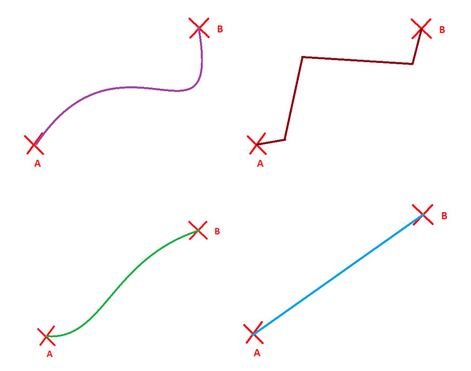
And many more, right? Now, the key question among all the lines we have drawn is: which is the shortest? In other words, what is the shortest distance between A and B? That’s it! The last line, the blue one. Here is another way to define a straight line, which is the shortest path between two points:
Between two points, the line is straight if it is the shortest path between them.
If it is not the shortest path, then it is not a straight line.
Wait! What about the second line we’ve drawn? This is a special case because it is not a single line but multiple lines.
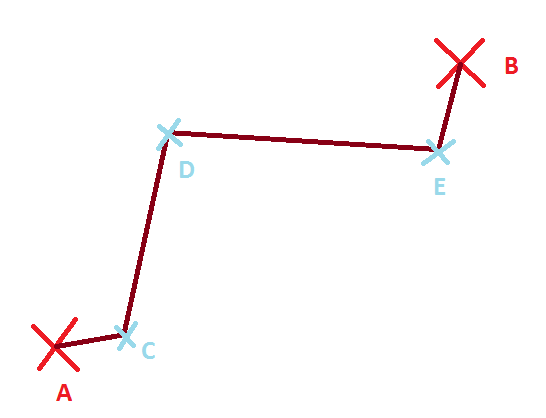
- The line that joins A with C.
- The line that joins C with D.
- The line that joins D with E.
- The line that joins E with B.
This case is called a polygonal line.
If you would like to learn more, check out our posts about straight lines and curved lines.
Remember when we said before that Euclidean Geometry was flat geometry? If points A and B used to be on the surface of a sphere – for example, a ball – you wouldn’t be able to draw a straight line without going through the ball!
Types of Straight Lines in Space Depending on the Arrangement
Horizontal Line
Horizontal lines are those drawn in the direction of the horizon, left to right, or vice versa. They are perpendicular to vertical lines, forming a 90-degree angle.
Vertical Line
Vertical lines are those drawn up and down, or down and up.
Oblique Line
Oblique lines are those that are neither vertical nor horizontal and do not form right angles when they intersect.
All straight lines divide the plane into two parts. To understand this, draw a straight line on a piece of paper – not near one of the edges – and you will divide the paper into two. If it is a horizontal line, you have parts above and below, and if it is vertical, you have parts on the left and right.
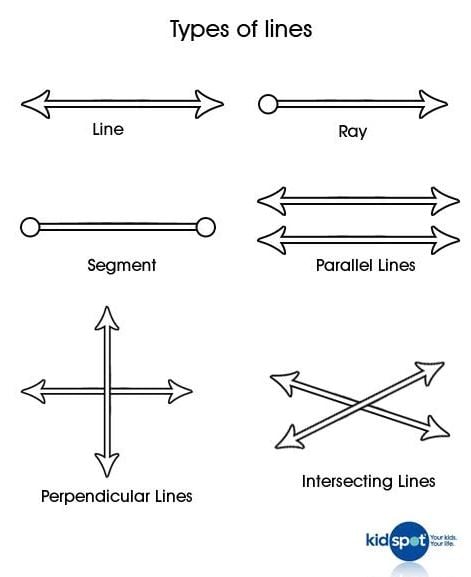
Types of Straight Lines According to the Position Between Them
Parallel Straight Lines
Parallel lines lie on the same plane and remain a fixed distance apart because they never intersect or touch at any point, not even their extensions.
An example of parallel lines is train tracks, even if they appear to meet in the distance. Have you ever heard that straight lines touch infinity? It is because the train tracks seem to come closer, but that isn’t true. Besides, infinity is not a point, so saying that they touch infinity is a strange way of saying that they do not touch.
Intersecting Lines
Intersecting lines are cut at one point, and the two lines form four angles, none of which are right angles.
Perpendicular Straight Lines
Perpendicular lines are a particular type of intersecting lines; in addition to being cut at one point, they form four right angles (90-degree angles).
In all of these drawings, we have segments, pieces of lines that end. If we tried to draw complete lines, we would never finish because they are infinite.
Video About the Relationships Between Lines
To keep learning, take a look at this video in which Amy and Zoe explore the relationship between lines.
If you would like to see more of our interactive tutorials and continue learning about geometry and other math topics adapted to your level, register with Smartick and try it for free.
Learn More:
- Learn More about Straight Lines
- Elementary Geometry – Open Figures
- Learn about Open and Closed Curves
- What is a Straight Angle and Examples
- Geometric Figures and Straight Lines





A multidisciplinary and multicultural team made up of mathematicians, teachers, professors and other education professionals!
They strive to create the best math content possible.
I’m sure I’m not alone in saying that what you have written about Euclid’s contributions to mathematics is appreciated.
E.B.
I learn a lot, ok.
Thanks for reminding us of the basic mathematical history in a simplified manner.
That was comprehensive. Need more
Hi Utthaan:
If you want to learn more about geometry and much more you can do so by trying our free trial in https://www.smartick.com
Thank you!