



Index
What is Speed?
Speed tells us how quickly something moves from one place to another. Whether you are walking, running, riding a bike, or driving, speed is what determines how fast you are going. For example, imagine running from home to school. If you run quickly, you’re moving at a high speed. If you jog or run slowly, your speed is lower. Besides how fast something moves, we can also consider the direction of motion.
Positive Speed ➕
Speed is positive when you move in the direction you picked as positive. For example, if you decide north is your positive direction, your speed is positive while moving northward.
Negative Speed ➖
Speed is negative when you move in the opposite direction from the one you chose as positive. So, if you’re running southward instead of north, your speed is negative.
Now that you understand speed and direction, let’s see how to calculate speed. There’s a simple formula to help us!
Speed Formula
- Distance refers to the measurement in meters, miles, or other units between two locations. For instance, if you walk from your house to the store, the distance is the total amount you travel.
- Time is how long it takes you to go that distance.
Speed = Distance / Time
For example, if you go 100 meters in 20 seconds, you would calculate your speed as:
Speed = 100 meters / 20 seconds = 5 meters per second (m/s)
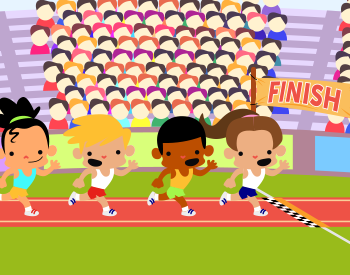
Average Speed
Average speed represents your overall speed throughout a trip. During a trip, speed changes when you stop at traffic lights or accelerate on the highway. Average speed provides a general measure of how fast you travel.
To find the average speed we use the same formula as before:
Average Speed = Total Distance / Total Time
If a car goes 150 km in 2 hours, its average speed is 75 km/h, even if it went faster or slower at different times.
What Is Acceleration?
Acceleration Formula
The formula to calculate speed is:
Acceleration = Change in Speed / Time
Change in speed is how much your speed increases or decreases from the start to the end. Imagine you are riding a bicycle.
To find the change in speed, subtract the starting speed from the final speed:
Change in Speed = Final Speed – Initial Speed
Here are some examples of when acceleration is positive or negative.
Positive Acceleration (Increasing Speed)
Imagine you are in a car that accelerates. If you start at 20 km/h and reach 50 km/h after 5 seconds, here’s how to calculate speed in this case:
- Initial Speed = 20 km/h
- Final Speed = 50 km/h
Change in Speed = 50 km/h – 20 km/h = 30 km/h
Negative Acceleration (Decreasing Speed)
- Initial Speed = 15 km/h
- Final Speed = 5 km/h
Change in Speed = 5 km/h – 15 km/h = -10 km/h
Case Studies
Now that you know how to calculate speed, here are some examples of how speed is used in everyday life:
Track and Field Race 🏃♂️
- During a 100-meter race, athletes run as fast as possible to reach the finish line.
- Speed shows how quickly runners finish the 100 meters.
Car Trip 🚗
- You drive from your house to the supermarket, which is 5 kilometers away.
- You can find the car’s speed by dividing the distance (5 km) by the time it takes to cover that distance. If it takes 10 minutes, your average speed is 30 km/h.
Bicycle Ride 🚴♀️
- You take a bike ride around your neighborhood, covering 2 kilometers in 8 minutes.
- You measure your speed by finding out how many kilometers per hour you travel on average during your ride.
Train Ride🚄
- A train travels between two cities at a constant speed of 120 km/h.
- The train’s speed remains constant, so you can figure out exactly how long it will take to travel between the two cities based on the distance.
Throwing a Ball ⚾
- You throw a baseball, and a radar measures its speed in the air.
- The speed of your pitch is measured in kilometers per hour or meters per second. This tells how fast the ball moves after you threw it.
Fun Activities
Sprinting in the Playground
Objective: Practice how to calculate speed & understand how distance, time, and speed are related.
Materials: a tape measure, a stopwatch, cones, or markers.
Instructions:
- Measure 20-30 meters using a tape measure. Mark the start and finish line clearly with cones or markers.
- Arrange students into small groups for the race.
- Each group must run the marked distance while another student times them with a stopwatch.
- After running, students use the speed formula (Speed = Distance / Time) to calculate their speed.
- Students can compare their speeds and see how time affects their results.
Roller Coaster Game
Objective: Learn how speed changes and how to calculate acceleration.
Materials: Toy cars, sloped tracks (like boards or ramps), a ruler, and a stopwatch.
Instructions:
- Set up an inclined track for the cars.
- Let the cars roll down the track and measure the time it takes them to reach the end.
- Mark different points along the track and measure the speed of the car at those points.
- Students can calculate acceleration by seeing how the car’s speed changes from the start to the end of the track (Change in Speed / Time).
Try this: Change the track’s slope and see how it affects acceleration.
Knowing how to calculate speed helps us understand movement in the world. When we know how to calculate speed, we can measure how fast or slow we go in any situation using the formula: distance divided by time. This information can help us get better at sports, plan trips, travel, and improve other daily activities.
At Smartick, we help children develop their thinking skills through math problems and games that test reasoning, memory, and attention. Kids can enjoy these in the Virtual World after finishing their daily 15-minute session.
Sign up for Smartick and take advantage of our personalized online learning method that adapts to their learning pace for children aged 4 to 14.
Learn More:
- How to Solve Problems with Distance Conversions
- Inverse Proportionality: What Is It?
- Learn the Signs of the Power: Positive or Negative
- Direct and Inverse Proportionality Problems
- How to Calculate the Area?





A multidisciplinary and multicultural team made up of mathematicians, teachers, professors and other education professionals!
They strive to create the best math content possible.